
The model is a commodity. The system is the moat.
everyone has claude. but what actually separates the people who get leverage from the people who don't?

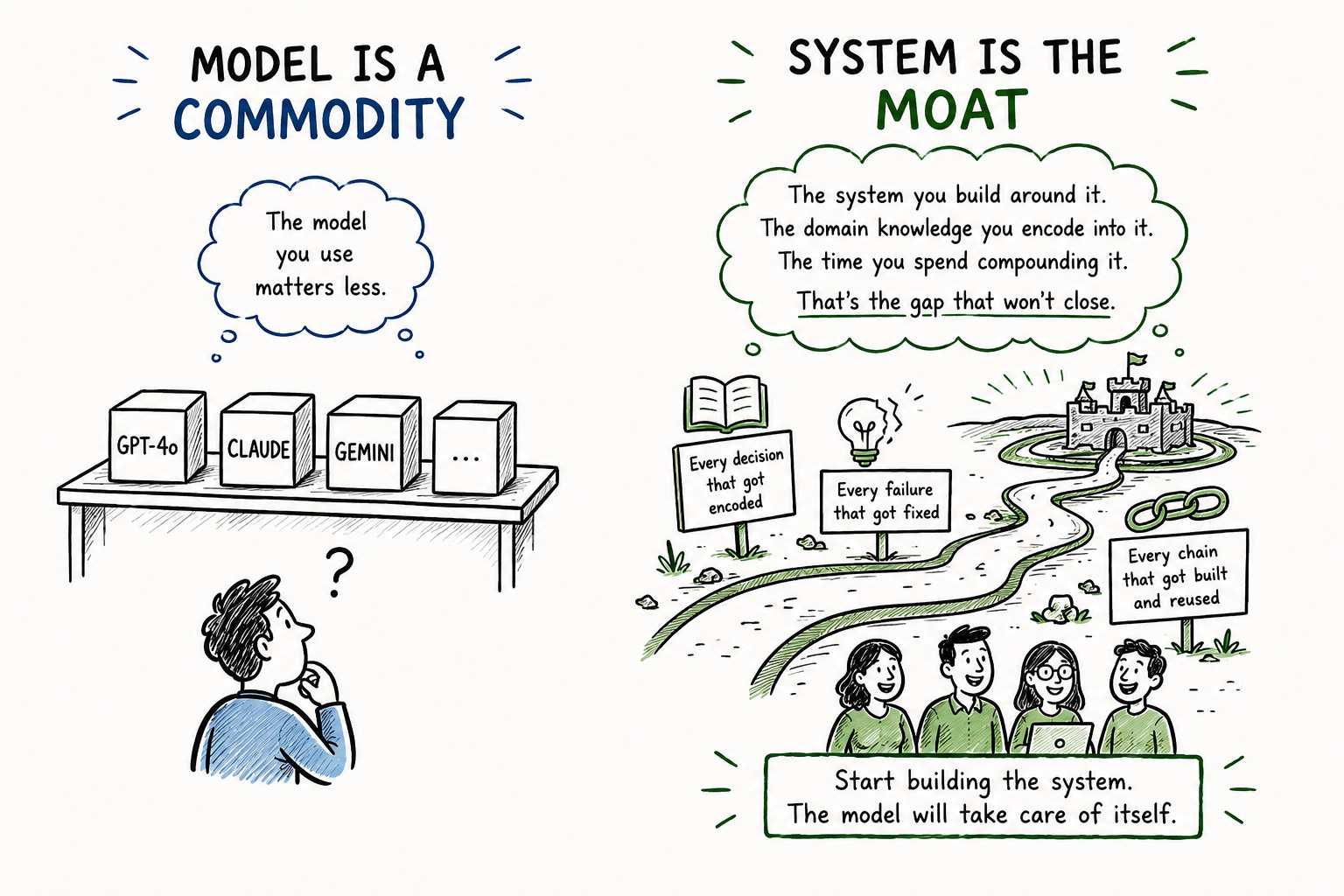
everyone has access to the latest models of Claude, GPT, Gemini and the other frontier models . the models are roughly equivalent for most tasks, and the gap between them is narrowing every quarter. if your competitive advantage in 2025 is “we use a better model than you,” that advantage expires in months.
the actual moat is what you build around the model.
i’ve spent the last several months building a personal AI system that has compounded into something genuinely useful. not useful in a demo sense. useful in the sense that i can ask it a question on Monday morning and trust the answer by Monday morning. i want to explain what makes it work, because it’s not the model.
what the system actually looks like
eight MCP servers connected to Claude: Gmail, Calendar, Drive, Sheets, GitHub, Figma, a data warehouse, a data catalog, Jira and Confluence. each one is a specialist. none of them operate in isolation.
the routing layer is 35 lines of markdown. it pattern-matches what i say and lazy-loads the right specialist agent for that query. this matters more than it sounds. context window is the scarcest resource in any AI system. treat it like RAM on a 1990s computer. you do not load everything at once. you load what you need, when you need it.
the moment i knew i needed a chain was when i asked “what is our conversion rate?” the system searches Confluence for the official metric definition. then it checks the data catalog for table lineage and data quality. then it writes SQL using the verified definition, not a guess. then it uploads the result to a Google Sheet. four tools, one question, no manual orchestration on my end.
that chain took time to build. it required decisions about what “conversion rate” means in our context, which table to trust, what quality checks to apply before surfacing a number. those decisions are encoded in the system. they do not live in my head anymore, which means i do not have to re-litigate them every time someone asks.
why i know this compounds, not just from AI
at Flipkart, we built an ML ops platform called OPUS. before OPUS, ten different product teams were running ML capabilities in silos. inconsistent feature engineering, no model versioning, no shared infrastructure. each team had reinvented their own version of the same wheel. the cost was not just duplication. it was that no one could build on what anyone else had built.
OPUS fixed that by creating shared infrastructure with team-specific configuration. what happened next was predictable in retrospect: once the plumbing worked, teams started compounding. a feature registry built for recommendations got reused in search. a model versioning pattern built for payments got applied to credit decisioning. the value of the system grew faster than the sum of its parts.
i see the same dynamic in the AI system i’m building now. the conversion rate chain i described does not just answer one question. it establishes a pattern: definition first, lineage second, quality check third, answer last. that pattern is now available to every query that touches metrics. i did not have to rebuild it. it compounds.
what most teams are still struggling to figure out
most teams treat AI adoption as a tool selection problem. which model should we use? Claude or GPT? should we try Gemini? this is the wrong question. or rather, it is a question that becomes irrelevant once you have answered the more important one: what is the workflow we are encoding, and how do we make it better over time?
i have seen this mistake in fintech repeatedly. at CheQ, we built CheQWisor, an AI credit assistant on Google Gemini 1.5 that processed 200+ credit card formats across Indian banks. the hard part was not choosing Gemini. the hard part was encoding the logic of what a credit card statement actually means, what edge cases exist across 200 formats, what the system should do when it encounters an ambiguous entry. that work is not model work. it is system work.
the model is the engine. the system is the vehicle. you can swap engines. you cannot easily swap the vehicle you have spent months tuning for the roads you actually drive on.
context window as the design constraint
i want to be specific about this because it changes how you architect everything.
the temptation when building AI workflows is to give the model as much context as possible. more context, better answers. this is wrong in practice. bloated context degrades response quality, increases latency, and makes the system expensive to run at scale.
the 35-line router exists precisely to fight this tendency. it loads the minimum viable context for the query at hand. a question about a calendar event does not need access to the data warehouse. a SQL question does not need email context. the discipline of deciding what to load, and what not to load, is where most of the design work actually lives.
this is not a Claude-specific problem. it is a fundamental constraint of how large language models work. the teams that build durable AI products will be the ones that treat context management as a first-class engineering problem, not an afterthought.
the intuition that does not transfer
i have been thinking about what the people building these workflows by hand right now are actually developing. it is not just familiarity with a set of tools. it is something closer to architectural intuition: when to route, when to chain, when to stop and ask for clarification versus when to proceed, how to encode domain knowledge without making the system brittle.
this intuition is not transferable by reading a tutorial. it comes from running the system daily, watching it fail in specific ways, fixing those failures, and watching what compounds versus what stays flat.
in five years, most of this will be packaged software. the routing layer i built in markdown will be a configuration screen in some enterprise product. the MCP server connections will be pre-built integrations you toggle on. the people who built it by hand will not have a technical advantage at that point. what they will have is the judgment to configure that software well, because they spent years understanding what the system is actually trying to do.
the actual takeaway
AI tools are commodities. AI workflows are the moat.
the model you use matters less than the system you build around it, the domain knowledge you encode into it, and the time you spend compounding it. the gap between a team with six months of daily workflow iteration and a team starting today is not the model they are using. it is every decision that got encoded, every failure that got fixed, every chain that got built and reused.
start building the system. the model will take care of itself.